描述
List of Tests:
Lab Test
- Alzheimer’s Blood Biomarker Test (p-Tau217)
Medical Consultation
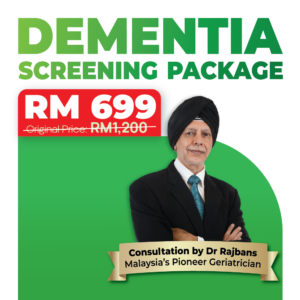
- Result review by Dr Rajbans (Malaysia’s Pioneer Geriatrician)

原价为:RM1,800.00。RM699.00当前价格为:RM699.00。
Alzheimer’s disease is the most common type of dementia and is associated with progressive changes in memory, thinking, judgement, and daily function. Our Alzheimer’s Screening uses a specific and targeted blood biomarker test to detect Alzheimer’s-related changes earlier, helping assess your risk up to 10 years before noticeable symptoms may appear.
Package Overview:
List of Tests:
Lab Test
Medical Consultation
Alzheimer’s disease is the most common type of dementia, accounting for around 60–70% of dementia cases.
It is a progressive brain disease associated with the buildup of abnormal proteins in the brain, which can gradually affect:
No.
Dementia is an umbrella term for conditions that affect memory, thinking and daily function.
Alzheimer’s is a specific disease and the most common cause of dementia.
Why screen earlier?
Alzheimer’s-related changes may begin years before noticeable symptoms appear.
A targeted Alzheimer’s blood biomarker test can help identify risk earlier, giving you and your family more time to seek further assessment, take appropriate action and plan ahead.
Specific & Targeted Alzheimer’s Screening
Unlike a general health screening, this blood biomarker test specifically looks for changes associated with Alzheimer’s disease.
Earlier Risk Detection
The test may help identify Alzheimer’s-related risk up to 10 years before noticeable cognitive symptoms appear.
Consultation by a Pioneer Geriatrician
Your results will be reviewed with Dr Rajbans, providing professional guidance based on your results and overall condition.
From Screening to Management
If concerns are identified, our team can guide you on appropriate next steps, further assessment and management.
Focus on Maintaining Independence
Early awareness gives patients and families more time to take action, manage risk factors and plan for maintaining daily function and independence.
1. What is Alzheimer’s blood screening?
Alzheimer’s blood screening is a specific and targeted blood biomarker test that looks for changes associated with Alzheimer’s disease.
It can help assess Alzheimer’s-related risk earlier, before significant symptoms develop.
2. Who should consider this screening?
You should consider screening if you:
3. Is Alzheimer’s the same as dementia?
No.
Dementia is an umbrella term, while Alzheimer’s is a specific disease and the most common type of dementia.
Alzheimer’s accounts for approximately 60–70% of dementia cases.
4. What does the screening include?
The package includes:
5. How is this different from the Dementia Screening Package?
They are two different screenings.
Dementia Screening Package
A broader assessment of memory, thinking and overall health to identify cognitive changes and possible contributing causes.
Alzheimer’s Screening
A specific and targeted blood test that assesses biomarkers associated with Alzheimer’s disease.
6. Can this test detect Alzheimer’s risk 10 years earlier?
Alzheimer’s-related biological changes can begin years before noticeable symptoms appear.
Research on p-Tau217 has shown that this biomarker may help identify individuals at increased risk of developing cognitive impairment within a 10-year period.
The result should always be interpreted together with your medical history and clinical assessment.
7. Do I need to fast before the blood test?
No, fasting is not needed for this test.
8. What happens if my result indicates an increased risk?
Your result will be reviewed during your consultation.
Depending on the findings, further evaluation or appropriate management may be recommended to better understand your cognitive health and plan the next steps.
Dementia Screening Package + Alzheimer’s Screening
The two packages assess different areas:
Dementia Screening
Checks thinking, memory and possible contributing causes.
Alzheimer’s Screening
Checks specifically for Alzheimer’s-related biomarkers.
Two different screenings. One more complete assessment.